
Today, we are releasing security updates for Icinga 2 fixing multiple security issues. Users are advised to upgrade immediately, as two of them allow an unauthenticated attacker to take over or...
Releasing Icinga 2 v2.16.2, 2.15.4 and 2.14.9
Today, we are releasing security updates for Icinga 2 fixing multiple security issues. Users are advised to upgrade immediately, as two of them allow an unauthenticated attacker to take over or...
Icinga Director, vSphere® Integration, and SSO: New Releases Available
This release roundup brings together Icinga Web SSO v1.0.0, Icinga Director v1.11.9, and Icinga vSphere® Integration v1.8.4. It introduces OpenID Connect single sign-on for Icinga Web and includes compatibility updates for the upcoming Icinga PHP Library 1.0.0...
Icinga 2 Security Update Preannouncement
The Icinga team would like to announce the forthcoming releases of Icinga 2 versions 2.16.2, 2.15.4, and 2.14.9. These releases will be made available on Monday 29th June 2026 between 12:00 and 14:00 UTC. These Icinga 2 releases will be security-fix releases...
Releasing Icinga Certificate Monitoring v1.3.0
Today we’re announcing the general availability of Icinga Certificate Monitoring in version 1.3.0. You can find all issues related to this release on our Roadmap. Please also refer to the corresponding upgrade section in the documentation. What’s New? We have made a...
Releasing Icinga Business Process Modeling v2.5
Today we’re announcing the general availability of Icinga Business Process Modeling v2.5.0. You can find all issues related to this release on our Roadmap. A Browser's Nemesis Since the very beginning, Icinga Business Process Modeling provides the possibility to...

Dependency Redundancy Groups in Icinga 2.14
Icinga 2.14 introduced a new feature that allows to better model complex dependencies between your hosts and services: redundancy groups. Let's take an e-mail server as an example. In order to deliver outgoing messages, it has to look up the addresses of the...
Releasing Icinga Ansible collection v0.3.0
This release of the collection will feature a whole set of possibilities to deploy a complete Icinga 2 environment. Before diving deep into the collection, a quick recap of all roles which were available and which are included in the current release v0.3.0. repos: The...
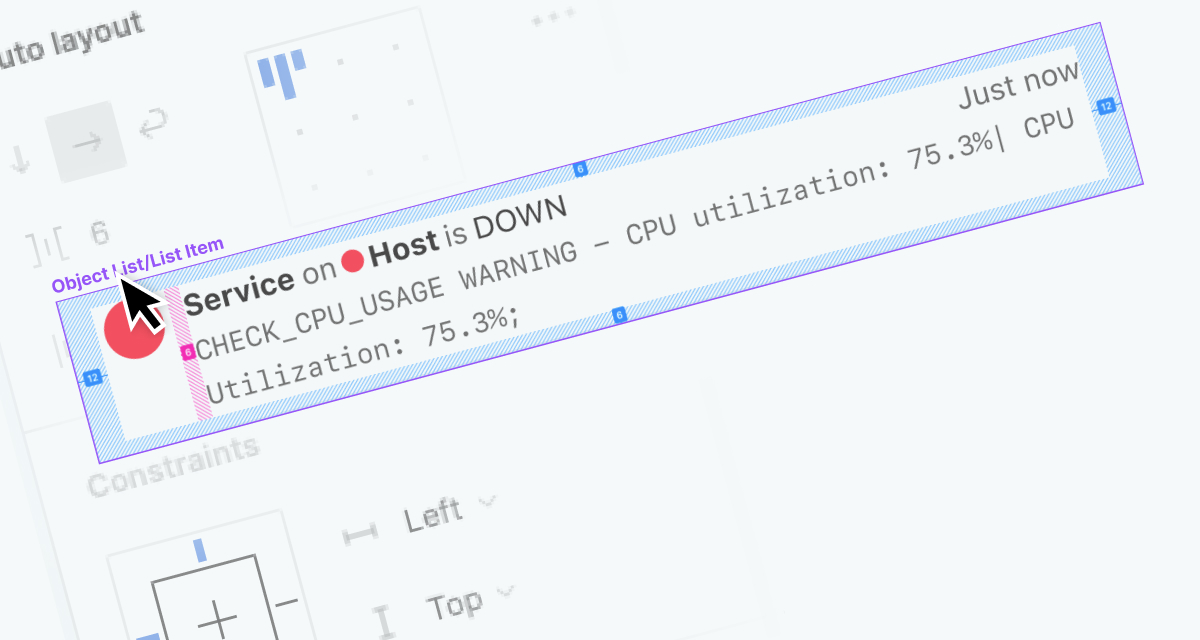
Figma’s powerful Auto Layout Feature
While it might be different within organizations, most demonstrations of Figma features publicly available use case you can see on the Internet are pretty basic. It makes sense for demonstration purposes, but I’d like to show how I use more complex Auto Layout setups...

Content-Security-Policy: How to add inline CSS to HTML Documents in Icinga Modules
Since the Icinga Web 2.12 release we have added a setting to enable content security policy in Icinga Web. This provides security against Cross-Site Scripting (XSS) attacks when the setting is enabled. This is done by adding Content-Security-Policy in our HTTP...
Releasing Icinga DB Web v1.1
Today we’re announcing the general availability of Icinga DB Web v1.1.0. You can find all issues related to this release on our Roadmap. Please make sure to also check the respective upgrading section in the documentation. Things You Eagerly Waited For Keyboard...

Releasing Icinga Web v2.12
Today we’re announcing the general availability of Icinga Web v2.12.0. You can find all issues related to this release on our Roadmap. Please make sure to also check the respective upgrading section in the documentation. PHP 8.2 Support This release finally adds...

What Is DevRel? Developer Relations Explained
DevRel meaning and definition DevRel is short for Developer Relations. Developer Relations is exactly what it sounds like, a marketing policy that prioritizes relationships with developers. In general society, there is a word known as PR which means Public Relations....

Subscribe to our Newsletter
A monthly digest of the latest Icinga news, releases, articles and community topics.