
Customer Story
Rohde & Schwarz
In the Technology Systems Division Rohde & Schwarz designs, develops, and implements systems based on customer requirements. When it comes to monitoring, they trust in Icinga to deliver systems with high reliability, exceptional performance, and optimal efficiency.

Rohde & Schwarz is striving for a safer and connected world with its Test & Measurement, Technology Systems and Networks & Cybersecurity Divisions. For over 90 years, the global technology group has pushed technical boundaries with developments in cutting-edge technologies. The company’s leading-edge products and solutions empower industrial, regulatory and government customers to attain technological and digital sovereignty.
The privately owned, Munich based company can act independently, long-term and sustainably. Rohde & Schwarz generated a net revenue of EUR 3.16 billion in the 2024/2025 fiscal year. On June 30, 2025, Rohde & Schwarz had more than 15,000 employees worldwide.
The Challenge
Before Icinga, all product extensions were very time-consuming and involved new release tests.
As a system integrator and manufacturer of core components, Rohde & Schwarz offers turnkey solutions by both integrating its own components as well as third-party tools. In their Technology Systems Division, the company bundles technological system expertise and resources to deliver products for communications, reconnaissance and security systems for armed forces, security authorities as well as operators of critical infrastructures. These client solutions range from small-scale setups to nationwide interconnected systems.
Monitoring Sensitive Sites
Icinga is used in the departments Critical Infrastructure and Secure Communications. Complete solutions are built according to customer requirements. Application areas include for example Naval Communication Solutions, as well as communication and signal intelligence for police and border control.
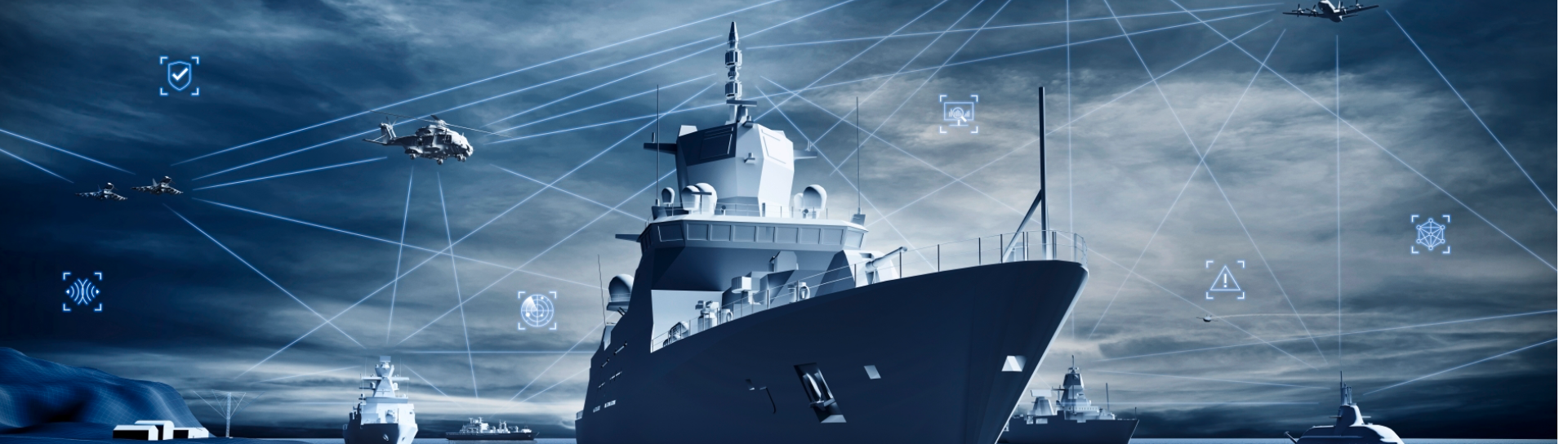
Over the last few decades, communication on navy ships has evolved into a complex matter. It goes beyond traditional voice communication between ships and shore stations. It now encompasses tactical data transmission and onboard communication among soldiers. With a crew of 250 members, effective coordination and secure communication channels are imperative. Rohde & Schwarz is a technology leader in providing solutions to address all these requirements.
Handling software in critical infrastructure projects, such as navy ships, is always
tricky. Replacing components requires a new certification and approval from the customer. Therefore, using an open-source solution gives us a significant advantage.
Incorporating Icinga into Turnkey Systems
The systems consist of Rohde & Schwarz devices and software solutions, as well as solutions from other manufacturers including IT and network hardware, possibly vehicles, or even complete building infrastructure. Rohde & Schwarz provides everything as a one-stop solution, allowing the customer to get up and running quickly and easily.
To fit their specific needs, Rohde & Schwarz expands Icinga by integrating components and features and then incorporates those into their systems. The overall solution is called “RS CHM”. Although the interface is customized and branded as “RS CHM”, the backend runs an unmodified version of Icinga.
Ralph Schmeisser, Product Owner Systems Status Monitoring, recounts how they began using Icinga1 10 years ago and switched 4 years ago from Icinga1 to Icinga2 as base for “RS CHM”. Within the development team several customizations were implemented in order to fullfil the various customers’ needs during that time. The same team supports deployment and maintenance phases in the customers’ installations, ensuring a smooth hand-over from R&D to operation.
Icinga monitoring runs at the customer’s site because external access to the systems is not desired for critical infrastructure.
In such customer projects, the infrastructure is set up once and remains largely unchanged. For the subsequent operation, the customer is responsible. Typically, they enter a long-term support contract with Rohde & Schwarz for for several years. A Navy ship project can range over 15 or more years, so using a closed-source application means a high risk for a vendor lock-in.
Icinga in 3 words? Flexible, extensible, reliable.
High Flexibility and Integrability
The challenge for Rohde & Schwarz was to find a highly flexible infrastructure monitoring tool that could be integrated with various components. Ralph Schmeisser explains, “There were several products from Rohde & Schwarz and third-party components that provided system status information, but there was no solution with a single interface showing the status of all the devices and components in one interface. That was unacceptable for such complex systems.”
To address this challenge, Ralph Schmeisser looked to the open-source world. The key requirements for the new monitoring tool were maximum flexibility in integration options, high scalability, and the ability to implement a distributed monitoring strategy. On top of that they wanted to avoid vendor lock-in. Ralph explains the value of an open-source solution for them: “We can build and patch the software ourselves and are not dependent on others. We highly appreciate working with the community; response times on Github are usually very quick.”
The Solution
Developing Commercial Solutions
The product “RS CHM” is a commercial “pre-packaged” solution of Icinga built with modules and extensions. Rohde & Schwarz have their own plug-ins and configuration logic. Various proprietary check-plugins and modules are used for specialized requirements in distributed monitoring, such as overcoming filters and gateways. The goal is to achieve an extended monitoring capability without compromising on aspects such as easy installation or configurability.
Currently, the team serves approximately 50 customers in around 300 different customer projects worldwide.
Distributed Monitoring and High Availability
There are small-scale solutions with a single Icinga instance that monitors all components, e.g. in a truck or ship. There are also very large composite systems, some of which are nationwide systems with multiple remote satellites and a 1-2 master high-availability setup. These systems have various network connections, including LAN or WiFi, satellites, radio devices, or LTE.
One essential requirement for the monitoring solution is scalability. The smallest Icinga installation monitors 2 hosts and 20 services, while the largest one consists of 20 satellites, each with 30-50 hosts, each hosting 20-30 services.
Icinga is our core, and we develop a lot of check-plugins for both our own and third-party components, which are also planned to be made available online – we release them under GPL.

Success
Icinga 2 has a beautiful API and a robust backend, and we’ve woven some business processes around it.
Broad Usability
Rohde & Schwarz is very content both with Icinga’s performance and flexibility for theirvarious use cases. While the Rohde & Schwarz components track a missing person’s mobile phone signal in radio detection or captures foreign radio signals, Icinga comprehensively monitors RS devices and environmental conditions, Dell servers, Lancom switches, door contact sensors, temperature sensors, diesel generator fuel levels, air conditioning, UPS units, as well as various software components. This includes monitoring all databases and their fill levels, as well as all processes.
Traditional notifications are not required because the client systems are isolated from external interfaces, meaning they cannot communicate externally for security reasons. However, Rohde & Schwarz has developed a notification GUI that queries the Icinga API and shows status changes. This allows for alarms in Windows without the need to keep a web browser open. Additionally, they have implemented an aggregation logic to deliver
condensed status information to combat management and other systems via SNMP.
The goal is that the workflows are more consistent, so that I don’t have to jump back and forth between several applications – there’s one application where all the data comes together.
Two Years On: Towards Unified, Headless Workflows
Since the original story was published, Rohde & Schwarz has been working on making “RS CHM” fit even more seamlessly into customers’ day-to-day operations. Complex use cases often involve several applications running side by side – CHM being just one of them – and operators previously had to switch between them to get a full picture.
Rohde & Schwarz is therefore moving towards a headless approach: rather than relying solely on the Icinga Web frontend, monitoring data is increasingly surfaced through a dedicated API layer and embedded directly into other applications. Icinga itself keeps running in the background as the monitoring engine, while the customer works within a single, consistently designed interface – without having to jump between tools.
Icinga Web will continue to be deployed for many customers, but for newer requirements, this unified, single-application experience is becoming the norm – improving day-to-day workflows for operators without asking them to learn a new tool.
Balancing Security, Features and Stability
Security updates have become an increasingly important topic for Rohde & Schwarz’s customers, and the team ensures these are integrated and rolled out reliably. Feature updates, on the other hand, are handled with more care: many systems – a single class of navy ships can take 8 to 10 years to build – need their user interface to stay visually unchanged for years, since crews rotate between ships and familiarity matters.
New features are still developed and shipped continuously, but access to them is controlled through Icinga Web’s permission concept, so that existing customers see minimal disruption to how they operate the system while the underlying capabilities – “what happens under the hood” – are kept up to date.
Open Telemetry support – we saw that and were very happy about it.
Metrics and Open Standards
For performance and trend data – such as temperature curves or disk usage over time – Rohde & Schwarz currently relies on Graphite integration. With the wider industry moving towards containers, Grafana is increasingly coming into focus, and a future shift in that direction is not ruled out.
Rohde & Schwarz also welcomed two recent additions to Icinga: OpenTelemetry support and OpenID Connect support.
OpenTelemetry support is not yet actively used in production, but the team is pleased about the announcement, since it gives users more choice in where they want to route and view their metrics. Similarly, OpenID Connect is seen as a promising direction for the future.
Outlook: Moving Towards Containers
Until now, Icinga and the wider “RS CHM” solution have typically been deployed natively or on virtual machines. Migrating towards containers and Kubernetes is the next major topic on the roadmap for the coming months, as customer demand for this shift is steadily increasing, mirroring a trend already visible in more traditional industries such as insurance.
For components that are heavily customised, such as Icinga Web in its current form, Rohde & Schwarz expects to keep building its own container images. For other parts of the stack, such as the database backend, the team hopes to be able to rely on official Icinga container images largely unchanged, in order to reduce the amount of custom engineering required – though this approach is still being evaluated and not yet finalised.
Monitoring Hard- and Software Components
Ralph Schmeisser and his colleagues at Rohde & Schwarz are extremely satisfied with Icinga’s functionalities that perfectly fit their needs. They receive overwhelmingly positive feedback from their clients, who can easily spot crucial status information on the Icinga Web dashboard and always rely on the monitoring. The upgrade from Icinga 1 to Icinga 2 was a major step in enhancing the “RS CHM” solution’s performance, security, reliability, and usability- and the ongoing move towards headless, container-based deployments continues that trajectory today.
Outcomes
- Building Customized Client Solutions by Extending Icinga with Other Components
- Leveraging Icinga’s High Scalability and Flexibility for Different Use Cases
- Utilizing the Concept of Distributed Monitoring and High Availability
- Assuring Stable Operation of Complex and Critical Systems
- Moving Towards Unified, Headless Workflows and Container-Based Deployments
Tackle Your Monitoring Challenge
Learn about the basics and essentials of Icinga, and start your own Icinga by following our installation course.