
Introduction Icinga 2 makes heavy use of Boost.Coroutine2 in our network code, which are stackful coroutines that are designed to work well with the IO operations from Boost.Asio. This has proven to...

Exploring C++20 Coroutines: A Practical Look at Stackless Coroutines vs Boost.Coroutine2
Introduction Icinga 2 makes heavy use of Boost.Coroutine2 in our network code, which are stackful coroutines that are designed to work well with the IO operations from Boost.Asio. This has proven to...

Using Icinga 2 on NixOS
I use NixOS by the way. And today I'm going to show you how to operate a simple Icinga setup using that operating system. I.e. a single node with checks and notifications. In contrast to Icinga Web 2 or Redis, NixOS provides an Icinga 2 package, but no module....

Enhanced Icinga 2 Container Images
As some of you might have already noticed, we recently gave our official Icinga 2 container image builds a complete overhaul. These new images are currently available only as snapshot builds but will replace the existing stable images with the next Icinga 2 v2.16.0...

Replay Log in Distributed Icinga Environments
An essential part of a distributed monitoring environment with Icinga that includes master, satellite and agent nodes is the replay log functionality. The replay log is a built-in mechanism to ensure nodes in a distributed setup keep the same history e.g. check...
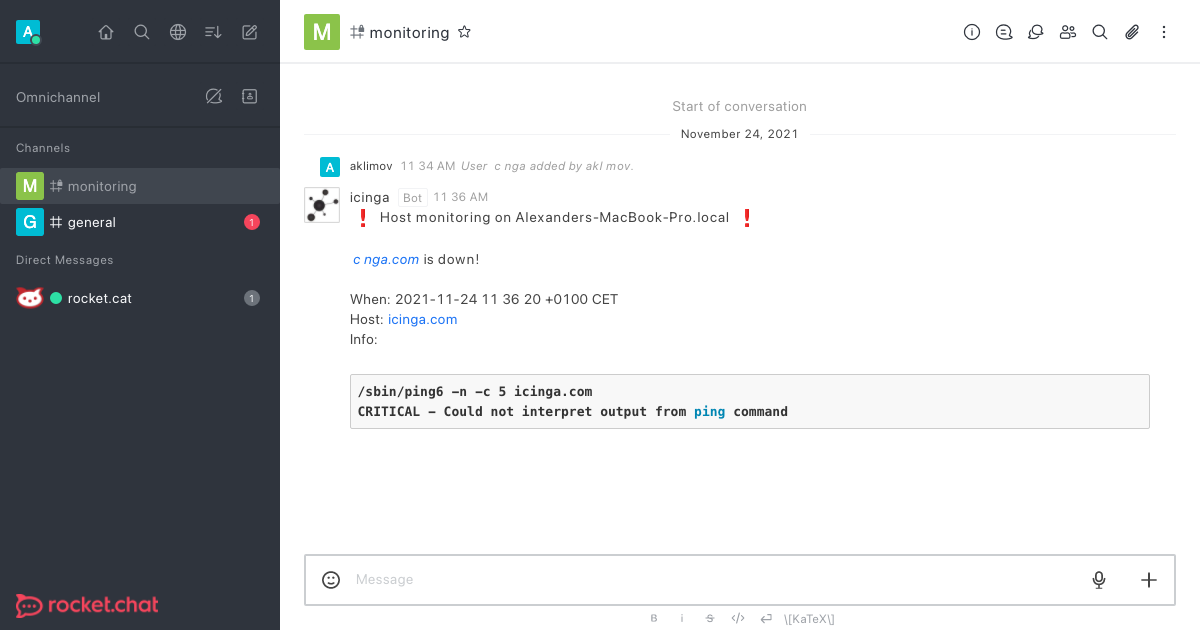
Icinga 2 Rocket.Chat notifications. The complete guide
About one year ago the NETWAYS colleagues showed you how to let Icinga 2 notify users through XMPP/Jabber. Now it's time to also cover the somewhat more fancy Rocket.Chat. No Rocket.Chat? No problem! Setting up a test system is pretty easy: Clone this Git repository...

How to monitor a web server running NGINX|httpd
Web servers are software services that store resources for a website and then makes them available over the World Wide Web. These stored resources can be text, images, video and application data. Computers that are interfaced with the server mostly web browsers...

What to expect from an Icinga Fundamentals training
Let's set the scene: You just started out with Icinga, maybe because you have realised your need for monitoring or you have inherited an environment. Maybe your boss just decided that this is what you are going to do now. So you are now sitting in front of the...
Icinga 2.13.1 + 2.12.6 + 2.11.11: Security and Bugfix Releases
Today we're releasing the security and bugfix versions 2.13.1, 2.12.6 and 2.11.11. The main focus of these versions is a security vulnerability in the TLS certificate verification of our metrics writers ElasticsearchWriter, GelfWriter, InfluxdbWriter and...
Releasing Icinga 2.13.0
Today we're releasing our next major version of Icinga 2. Icinga 2.13 includes many long awaited enhancements and bug fixes, but also a lot of smaller changes. Units of measurement This release adds a bunch of new and improved UoMs (Units of measurement) to Icinga 2....

Our Workflow for Security Releases using GitHub Security Advisories
We recently started using GitHub Security Advisories as part of our workflow for pushing out security releases. This post will give a brief introduction on how they work, how we use them, some of their limitations, and how we overcome them. We are still experimenting...
Icinga 2.12.5 + 2.11.10: Security Releases
Today we are releasing Icinga 2.12.5 and 2.11.10, including two security fixes that may lead to privilege escalation for authenticated API users. Depending on your setup, manual intervention beyond installing the new versions may be required, so please read the...

Monitoring the Monitor: How to keep a watch on Icinga 2
The question is (probably) older than monitoring itself: Who monitors the monitor? While Icinga comes with countless options to monitor a wide range of devices and applications, at some point you will ask yourself how you can observe if Icinga itself is having errors....

Subscribe to our Newsletter
A monthly digest of the latest Icinga news, releases, articles and community topics.